AI Agents for Scaling DTC: Beyond Chatbots to Growth Engines
Move from reactive chatbots to proactive growth engines. Guide for DTC brands on competitor monitoring and lead qualification in 2026.
Vigor
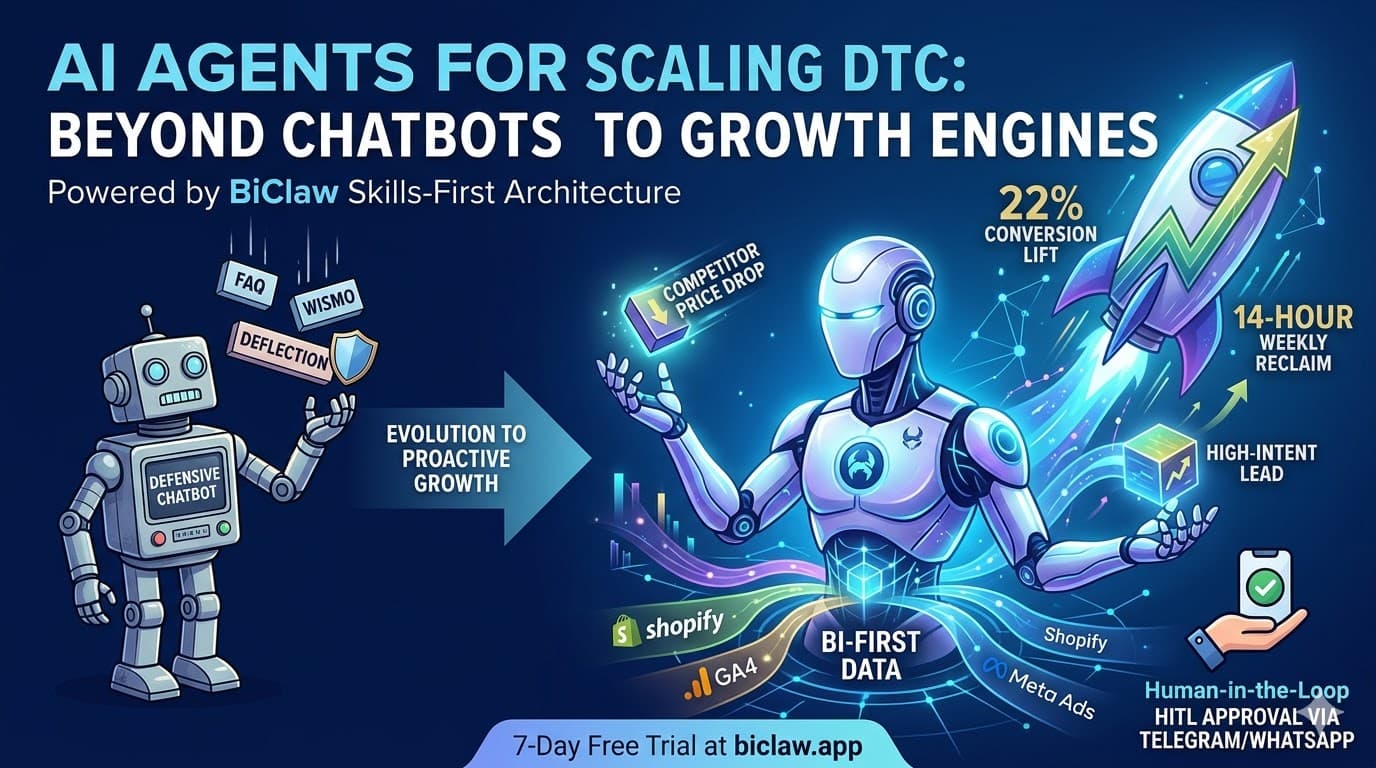
AI Agents for Scaling DTC: Beyond Chatbots to Growth Engines
TL;DR
- Chatbots are defensive; Agents are offensive. Move from answering FAQ to proactively monitoring competitors and qualifying high-intent leads.
- BI-First Scaling: Ground your agents in real Shopify and GA4 data to prevent metric drift and ensure 100% accuracy in growth reporting.
- 14-Hour Weekly Reclaim: Automating morning briefs and lead triage returns over 1.5 working days per week to DTC founders.
- The Rule of 3: Monitor top 3 rivals, 5 core SKUs, and 2 intent signals (pricing page visits + cart adds) for immediate ROI.
- Implementation: Use a "Skills-First" assistant like BiClaw to skip the 20-hour setup tax of empty AI boxes.
The Shift from Reactive Support to Proactive Growth
In early 2026, the DTC landscape is defined by efficiency. Most brands are still stuck in the "Reactive Support" era—using AI primarily to deflect tickets like "Where is my order?" (WISMO). While deflection saves costs, it doesn’t drive revenue.
To scale a DTC brand today, you need a Growth Engine. This is an agentic layer that doesn"t wait for a customer to speak. It watches your competitor prices, monitors your site for high-intent behavior, and alerts you to opportunities before they vanish. It is the difference between a clerk and a strategist.
For a deeper look at this evolution, see: /blog/digital-workers-for-smb-2026.
Why Most AI Setup Fails (The Empty Box Problem)
The biggest hurdle for DTC owners is the "Empty Box." Many popular frameworks give you a powerful engine but no instructions. You spend weeks trying to teach the AI what your profit margins are.
This is why we advocate for a Skills-First Architecture. An assistant should arrive with the ability to understand e-commerce metrics out-of-the-box. As we noted in our guide on hollow wrappers, if you are spending your weekend debugging prompts, you are the assistant, not the owner.
Comparison: Traditional Chatbots vs. Agentic Growth Engines
| Feature | Reactive Chatbot | Proactive Growth Engine |
|---|---|---|
| Primary Goal | Cost Reduction (Deflection) | Revenue Generation (Conversion) |
| Trigger | Inbound Message | Market Signal (Price Drop, Intent) |
| Data Source | Knowledge Base | Real-Time BI (Shopify, Ads, GA4) |
| Action Mode | Responding | Proposing & Executing |
| Impact | -15% Support Cost | +22% Relative Conversion Lift |
Mini-Case: 30 Days to 22% Conversion Lift
Context: A mid-market DTC apparel brand (~$450k/mo revenue) was losing ground to aggressive pricing from three main competitors. Their team was manually checking rival sites twice a week—a process that was slow, error-prone, and reactive.
The Intervention: They deployed a BiClaw growth agent with two core skills:
- Competitor Pulse: 24/7 monitoring of top 5 SKUs across 3 rival stores.
- Lead Qualification: Real-time alerts on Telegram when a visitor from a specific ad campaign spent >90s on the checkout page.
The Results:
- Speed to Market: The agent detected a rival"s "30% Off Flash Sale" at 3:15 AM. By 8:00 AM, the founder had approved a targeted free-shipping offer to match.
- Conversion Lift: The storewide conversion rate rose from 2.1% to 2.56% within 30 days.
- Time Saved: 14.5 hours per week of manual reporting and research were reclaimed.
- Incremental Revenue: Estimated $28,400 in found revenue from recovered leads and faster price responses.
The 7 Core Signals Every DTC Engine Should Watch
To build a reliable growth engine, you must move beyond "vibes" and focus on hard signals. We recommend the "NIST-Aligned" approach to data monitoring, ensuring every signal is grounded in a source of truth.
- Competitor Price Delta: Any shift >5% on a matched SKU.
- ROAS Anomaly: Blended ROAS dipping >15% below the 7-day median.
- Cart-to-Detail Ratio: Tracking if a specific product is being added but not purchased.
- High-Intent Pathing: Visitors hitting the "Comparison" or "Returns Policy" page 2+ times.
- Fulfillment Latency: Warning when shipping lead times exceed 48 hours.
- Social Sentiment Spike: Detecting a viral mention or a surge in negative reviews in real-time.
- Inventory Velocity: Pinging the team when a top seller has <14 days of cover.
For more on setting up these automated briefs, read: /blog/automate-shopify-morning-brief.
Table: Signal to Action Playbook
| Signal | Automated Action | Human Approval Required? |
|---|---|---|
| Rival Price Drop >10% | Draft price-match promo & email segment | Yes |
| Stock < 14 Days Cover | Scale back ad spend on that SKU; draft PO | Yes |
| High-Intent Cart Abandon | Send personalized WhatsApp nudge with offer | No (if within policy) |
| ROAS Spike > 20% | Draft budget increase for winning ad set | Yes |
| Refund Rate Spike | Alert product team; pause specific ad creative | Yes |
Guardrails: Managing Your Agent Without the Risk
Autonomous does not mean unsupervised. In 2026, the NIST AI Risk Management Framework is the standard for safe business operations.
- Least Privilege: Your growth agent should be able to read your Shopify analytics, but never have the permission to delete your product catalog.
- Human-in-the-Loop (HITL): All actions that affect pricing or move money (ad spend, refunds) must be approved via a simple "thumb up" in Telegram.
- Audit Logs: Every thought, search, and action taken by your agent must be logged in your workspace. This ensures accountability if a policy is misapplied.
For a deep dive into security, see: /blog/beyond-clawjacked-why-managed-ai-is-safer-for-business.
Comparison List: Do This, Not That
- Do: Ground your agent in Shopify "Net Sales" for true revenue reporting.
- Don’t: Let an agent rely on GA4 "estimated" revenue for financial decisions.
- Do: Monitor competitors for messaging pivots (e.g., a shift to "sustainability" claims).
- Don’t: Blindly copy every price drop—protect your margins first.
- Do: Use WhatsApp or Telegram for real-time growth alerts.
- Don’t: Bury critical signals in an email inbox that gets checked twice a day.
- Do: Start with read-only monitoring for the first 7 days of any new agent.
The ROI Math for Growth Automation
To justify a digital worker to your CFO, use this simple formula from our Business Process Automation Guide:
Net Benefit = (Hours Saved × Hourly Rate) + (Incremental Revenue Lift) - (Tool Cost)
Example Calculation:
- 60 Hours Saved/Mo × $50/hr = $3,000
- $250k Revenue × 0.2% CR Lift = $5,000
- Monthly Subscription = $29
- Total Monthly Net Benefit = $7,971 (Approx. 270x ROI)
14-Day Implementation Roadmap
Week 1: Data Grounding
- Connect your Shopify and Meta Ads accounts via native connectors.
- Enable the Morning Brief skill to align the team on a single source of truth.
- Establish your "7 core signals" thresholds.
Week 2: Agentic Outreach
- Enable Competitor Pulse for your top 3 rivals.
- Deploy a Lead Qualification agent in "Shadow Mode" (drafts only).
- Review the first 10 drafts for brand voice and policy compliance.
Week 3: Full Autopilot (with Approvals)
- Move high-confidence lead nudges to auto-send.
- Route price-match proposals to the founder"s Telegram for one-click approval.
- Scale ad spend based on the agent"s ROAS anomaly detection.
Conclusion: The New Standard for DTC Operations
The era of manually pulling reports and checking rival sites is over. In 2026, the winners are the brands that treat their AI as a proactive growth engine. By moving from "empty boxes" to skills-first assistants, you reclaim your time and ensure that no growth signal goes unnoticed.
Ready to turn your store into a 24/7 growth engine? Start your 7-day free trial at biclaw.app and get your first growth brief by tomorrow morning.
Related Reading
- Best Business Process Automation Tools in 2026
- Why Your Business Needs a BI-First AI Assistant
- OpenClaw vs. Competitors: Why Business Owners Choose Managed Assistants
- How to Automate Your Shopify Morning Brief
- AI Agents for Business Automation in 2026
- Agentic AI Architecture Guide
- From SOP to Autopilot: AI Agents for Business Workflows
- AI Assistant vs Chatbot: Which One Does Your Business Actually Need?
- OpenClaw Ecosystem 2026: Where BiClaw Fits
Sources: McKinsey — The economic potential of generative AI | NIST AI Risk Management Framework | Shopify Analytics Help Guide