Shopify Margin Protection: Solving SKU Profit Leaks with AI (2026 Guide)
How to stop SKU-level profit leaks on Shopify using agentic BI in 2026. Guide to SKU rationalization, POAS, and margin protection.
Vigor
Shopify Margin Protection: Solving SKU Profit Leaks with AI (2026 Guide)
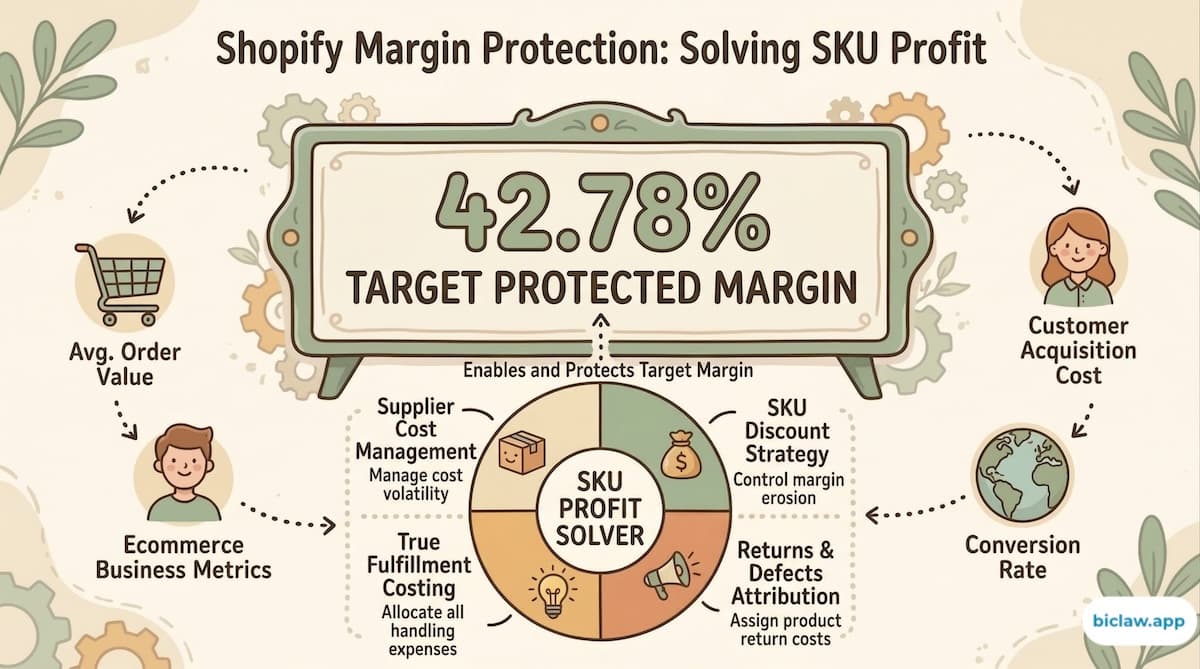
If your Shopify dashboard says you’re profitable but your bank account is shrinking, you are likely suffering from SKU-level profit leaks. In 2026, the game of e-commerce is no longer just about revenue. It is about net profit per unit. This guide breaks down the hidden costs eroding your margins and how AI agents can protect your bottom line by watching every SKU 24/7.
TL;DR
- The Profit Paradox: 62% of SKUs in modern e-commerce stores are estimated to be unprofitable after accounting for all hidden costs.
- Hidden Leaks: COGS is only part of the story; SKU-level profit is killed by transaction fees, inbound shipping, returns, and variable CAC.
- Agentic BI: Traditional dashboards are reactive; AI agents are proactive, flagging margin drift as it happens at the SKU level.
- Action Plan: Audit your SKU rationalization monthly, shift from ROAS to POAS, and automate stockout prevention to protect cash flow.
- Case Study: A Shopify brand recovered 14% in lost margin by automating SKU-level profit monitoring.
Why Revenue is a Vanity Metric in 2026
For years, Shopify merchants focused on top-line revenue. But in 2026, with Customer Acquisition Costs (CAC) up 40-60% over the last two years, revenue without a clear margin is a trap. You can sell $1M of product and lose $100k if your SKU-level math is off.
The challenge is that standard e-commerce reports often stop at gross profit. They ignore the "Last Mile" of expenses that happen between the warehouse and the customer"s doorstep.
The 5 Hidden SKU Profit Leaks
1. The "Blended CAC" Mirage
You might have an overall ROAS of 3.0, but that hides the reality that some SKUs have a ROAS of 6.0 while others are being sold at a loss (ROAS of 1.2). Without SKU-level ad spend tracking, you are subsidizing your losers with your winners.
2. Inbound Shipping and Tariffs
Most COGS estimates use a static number. In 2026, supply chain volatility means the cost to get SKU A from the manufacturer varies month to month. If your pricing doesn"t adapt to these "inbound leaks," your margin evaporates.
3. Payment and Platform Fees
Between Shopify"s base fees, payment gateway percentages, and the "app tax" of 5-10 third-party apps, your variable cost per transaction is higher than you think. These fees hit low-ticket SKUs the hardest.
4. The Return-Rate Sinkhole
A SKU with a 20% return rate needs a much higher initial margin than one with a 2% return rate. If you don"t factor in the labor and shipping cost of processing returns at the SKU level, you are losing money on every "sale" of high-return items.
5. Dead Stock and Holding Costs
Money tied up in non-moving SKUs is money you can"t spend on growth. SKU proliferation—carrying too many variants that don"t move—creates a silent drag on your cash flow.
How Agentic BI Protects Your Margins
Traditional Business Intelligence (BI) tells you what happened yesterday. Agentic BI tells you what to do today. At BiClaw, we use AI agents to act as "24/7 Margin Sentinels."
Instead of you logging into a dashboard to find a problem, the agent monitors the data streams (Shopify, Meta Ads, ShipStation) and pings you when a SKU’s net profit drops below a defined threshold.
| Traditional BI (Dashboards) | Agentic BI (BiClaw) |
|---|---|
| Reactive: You find the error. | Proactive: The agent flags the error. |
| Static: Shows charts. | Dynamic: Suggests actions (e.g., "Pause ads on SKU X"). |
| Manual: Requires human analysis. | Autonomous: Reconciles data across tools. |
| Delayed: Usually T-1 or T-7. | Real-time: Monitors SKU-level drift. |
To see how we implement these "Sentinels," read: /blog/scheduled-wins-3-agents-lean-teams-2026.
The Transition: From ROAS to POAS
The most important shift you can make in 2026 is moving from Return on Ad Spend (ROAS) to Profit on Ad Spend (POAS).
- ROAS = Revenue / Ad Spend
- POAS = (Revenue - COGS - Shipping - Fees) / Ad Spend
AI agents make POAS tracking possible at scale. By joining your Shopify order data with your Meta Ads spend in real-time, the agent can calculate the actual profit generated by every dollar spent on ads.
Mini-Case: Reclaiming 14% Margin for a Wellness Brand
Context: A 10-person Shopify brand selling supplements (~$350k/mo revenue) was growing revenue but seeing net profit stay flat. The Problem: High shipping costs for heavy glass bottles and a 15% return rate on one specific SKU were eating the gains. The Intervention: They deployed a BiClaw "Margin Agent" to perform SKU-level analysis. The Discovery: The agent found that their "Summer Bundle" was actually losing $2.50 per order after factoring in the increased weight-based shipping and a 3% payment failure rate on that specific bundle. The Result:
- Discontinued the unprofitable bundle within 48 hours.
- Shifted $5,000/mo in ad spend from the loser SKU to a high-margin "Refill Pack."
- Net Impact: Net profit increased by 14% in 30 days while revenue stayed identical.
3 Steps to Stop SKU Leaks Today
1. SKU Rationalization Audit
Perform a "Keep, Kill, or Optimize" audit every 30 days. If a SKU hasn"t generated a net profit in 90 days, kill it or bundle it to clear the inventory. Use an agent to automate this report: /blog/competitor-monitoring-tools-2026.
2. Automate Stockout Prevention
Stockouts are profit killers. When you run out of a winner, you lose the sale and your ad efficiency drops as the algorithm resets. Use an AI agent to monitor velocity and draft POs 14 days before you hit zero.
3. Deploy a Morning Brief Sentinel
Get a daily report that doesn"t just show sales, but shows "Estimated Net Profit." If your margin dips, you need to know before you spend your daily ad budget. Learn how here: /blog/automate-shopify-morning-brief.
Governance and Guardrails
When automating margin protection, follow the NIST AI Risk Management Framework (https://www.nist.gov/itl/ai-risk-management-framework). Never let an agent change your prices on the live store without a human "Approve" click in your chat app.
For more on safe agent operations, see: /blog/openclaw-security-stability-business-guide-2026.
Conclusion: Protect the Profit, Not the Revenue
The e-commerce winners of 2026 are those who master their SKU-level math. Don"t be a merchant who is "busy losing money." Use the power of agentic BI to watch your margins while you sleep.
Ready to see your real net profit? Start your 7-day free trial of BiClaw today at https://biclaw.app.
Related Reading
- /blog/automate-shopify-morning-brief
- /blog/ecommerce-analytics-tools-2026
- /blog/scheduled-wins-3-agents-lean-teams-2026
- /blog/dtc-ai-agents-workflow-automation-2026
Sources: Shopify SKU Rationalization Guide | McKinsey — The state of AI 2024